Strategic briefs
Sector and policy briefs for decision-makers. Rigorous, short, and intended to be read in one sitting.
Coordination is the scarce resource.
SVL is an applied research and strategy lab at Alfaisal University in Riyadh. We study how long-horizon national visions become institutions, markets, firms, capabilities, and measurable public value. Our anchor case is Saudi Vision 2030.
By coordination, we mean the institutional capacity to align rules, capital, markets, data, firms and capabilities across time.
National transformation works across four connected layers. A vision must be financed, institutionalised, translated into markets, and converted into durable capability. SVL studies those layers together because failure usually appears between them.
Direction, staged commitments, option value, and strategic attention.
Rules, rails, incentives, governance, and delivery routines.
Capital, talent, procurement, supplier depth, and trust.
Research systems, sectors, implementation capacity, and public value.
Strategic visions are coordination architectures.
They are not only plans, forecasts, or slogans. They are ways of coordinating institutions, capital, markets, firms, data systems and public capabilities across time.
SVL studies how those architectures work in practice. Saudi Vision 2030 is our anchor case: a digitally enabled institutional transformation at national scale. Comparative cases help separate what is uniquely Saudi from what may travel: sovereign capital, digital public infrastructure, sector formation, talent systems, and delivery routines.
Focal point, direction, public commitment.
Staged commitments, option value, capital discipline.
Rules, rails, registries, regulators.
Signals, prices, procurement, demand.
Sectors, suppliers, ecosystems.
Talent, R&D, implementation capacity.
Measurable public value; diversified growth.
Research, measurement, teaching, and tools — produced for decision-makers in government, capital, universities and firms.
Sector and policy briefs for decision-makers. Rigorous, short, and intended to be read in one sitting.
Measurement tools for institutions, markets, sectors, and implementation capacity.
Workshops, roundtables, cases, and micro-credentials for senior practitioners.
Dashboards, simulations, and AI-supported workflows for strategy implementation.
| NOW | +6M | +12M | |
|---|---|---|---|
| Talent | |||
| Suppliers | |||
| Procurement | |||
| R&D | |||
| Capital | |||
| Trust |
SVL builds prototype tools that help strategy teams test scenarios, map capability gaps, and turn long-horizon plans into staged implementation choices.
SVL's books develop the deeper arguments behind the briefs: how Vision 2030 works economically, how AI changes strategy, and how finance adapts when intelligence becomes cheap and coordination becomes scarce.
SVL is Saudi-first and comparative. Each programme couples rigorous theory with a defined site of practice.
How national visions are structured, governed, sequenced, measured, and adapted.
Digital identity, registries, e-invoicing, data infrastructure, and market formation.
How new firms, ecosystems, venture capital, universities and giga-projects interact.
Sovereign wealth, fiscal discipline, option value, staged investment, and reallocation.
AI-enabled systems, simulations, dashboards, and institutional data flows that improve implementation.
UAE, Oman, Qatar, Malaysia, Indonesia, Singapore, Kenya, Rwanda, and other long-horizon transformation models.
Saudi Vision 2030 is SVL's anchor case. The atlas places it alongside eight other long-horizon national strategies to compare how countries use capital, institutions, digital systems and public commitments to coordinate transformation.
Working-paper examples that translate strategic questions into rigorous, usable analysis. Full drafts are shared selectively with collaborators and partners.
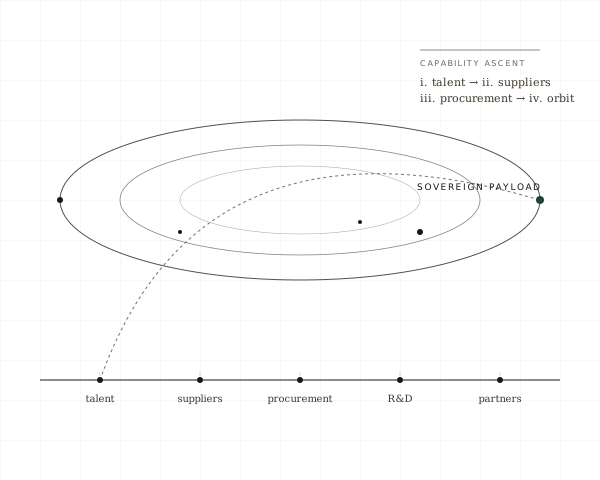
A serious space programme is a national capability test. It pulls on engineering talent, supplier depth, sovereign procurement, R&D, and international partnerships. The brief treats space as an industrial strategy instrument and asks what is required for orbit-capable infrastructure to build terrestrial capability.
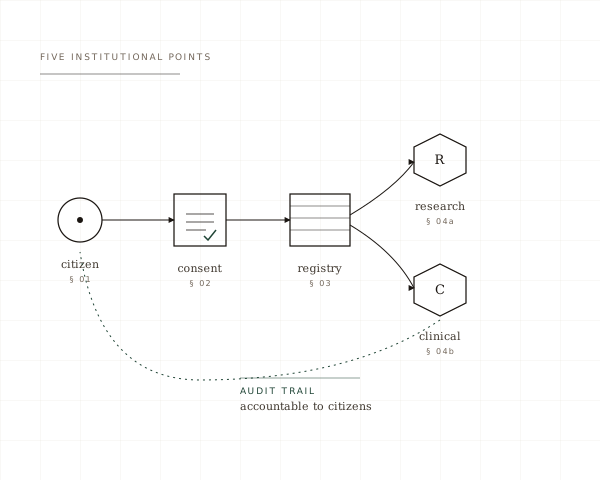
Trusted health-data infrastructure could improve population health, clinical quality, and life-sciences research. The institutional question is governance: how to align consent, auditability, registries and research access without compromising public trust. The brief sets out a five-point governance frame and an audit-trail standard for sensitive secondary use.
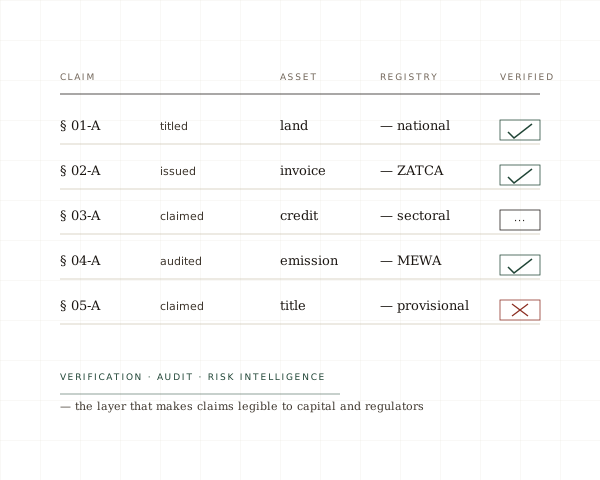
The durable infrastructure opportunity is the verification, audit and risk-intelligence layer that makes real-world claims legible to capital and regulators. The brief examines how Saudi institutional rails — identity, registries and e-invoicing — could support a trusted-claims architecture for finance and sector formation.
SVL's founding directors bring institutional economics, entrepreneurship and ecosystems, and finance and portfolio theory to applied work on national transformation.

Institutional and innovation economics; national transformation strategy; Vision 2030 as economic strategy; evolutionary economics.

Entrepreneurship, innovation ecosystems, AI and work, product strategy, research-to-practice systems, and applied build capability.

Finance, capital markets, portfolio theory, investment analysis, valuation, and strategic capital allocation.
SVL works with public, private, and university partners on briefs, sector reports, diagnostics, executive roundtables, student practicums, and data-to-decision prototypes connected to national transformation.